Monday, December 17, 2007

Pluto

Mangaka: Urasawa Naoki

The original Astro Boy manga introduced young readers to the realities of racial conflict by presenting them on a level children could understand and discuss with their parents, but this meant that Tezuka could not fully explore the more mature psychological and moral issues in the background of Astro's grim world. The rough and episodic nature of Astro's adventures and the long time over which Tezuka developed the world and character also limited his capacity to bring to the fore the emotional and philosophical potential of the universe and characters he had created. Naoki Urasawa's Pluto is, quite simply, Astro Boy for adults. The work is a retelling of the Pluto chapter of Astro Boy, originally entitled 'The World's Strongest Robot,' which looks at the seven most powerful robots on earth as their programming and human vanity force them to fight one another. The original story focused on Astro being asking why humans create these temporary life forms, robots, then bind them to specific programs and hardware which lock them into limited roles in life, and why ultimately do humans make robots destroy each other. Naoki Urasawa preserves this central question, but adds to it many subtler questions about the psychological and social tensions which would arise in a society as densely populated with robots as Astro's.

One new question is how the existence of extremely human-like robots affects both human and robot identity. How do non-humanoid robots feel about those robots who can 'pass' for human? How do humans feel about their growing inability to distinguish human from robot? How do low-powered robots feel about the sophisticated robots who are immeasurably more powerful and important than they are, not by chance, but by human design? How do other high-powered robots feel about Astro, whose uniquely sophisticated electronic brain makes him the only robot to have real human-like learning capacity and to experience nearly-human emotions, and who is also the most universally beloved robot ever created? One might envy Astro as the 'ambassador of peace,' friend to all humans and robots, destined to bring the two races closer, or one might pity Astro as the first robot truly capable of feeling the pain of the conflict between the races and the loneliness of being the only one.


Another focus is robots' capacity to love and have family. The central character followed by the narrative is actually not Astro but the robot detective Gesicht, one of the original Great Seven robots, who is assigned to investigate the Pluto case. Following him we see the experiences of a humanoid robot working with human and robot colleagues, human and robot victims and human and robot witnesses. We also see him living with a robot wife, and dealing with the widows and orphans left when robots are destroyed. The backgrounds and families of the other Great Seven are also filled in, and we see how different super-robots have or have not imitated human lifestyles and friendships. It is also our first real chance to meet Astro from the perspective of an outsider, rather than taking the boy hero as our point of view. References to Astro's home and family remind us of the grim fate of the robotic parents Dr. Ochanomizu created for Astro who, as we recall from the original manga, will be destroyed at Dr. Tenma's order.

Urasawa also adds a detailed investigation of how the existence of super-robots would affect war and the balance of global politics. Taking the shallow political despot who was responsible for the conflicts in the original story, Urasawa creates instead a very realistic middle-eastern war, similar to those which have been so controversial in the last years, and then asks how the existence of robots would change it. How do robots, who are forbidden by their programming from harming humans, feel about fighting wars for the humans where they are forced to destroy one another while unable to harm others? How would mechanized armies change the speed and cost of warfare? How is it fair for there to be a Robot Law when there is no corresponding Human Law limiting humans' capacity to do harm to one another or to robots? And does making robots more and more human also inevitably mean making them capable of hate, irrationality and murder? These philosophical themes are not absent in the original Astro Boy manga, but here Urasawa has brought them much more to the foreground, presenting a mature philosophy of warfare which is clearly closely related to Tezuka's own treatment of it, both in early works like Metropolis and in late social commentaries like Adolf and Ayako.

The art style of Pluto is perhaps as starkly different from Tezuka's original as it is possible for art to be. In Urasawa's rendition, all people and places are reproduced in near-photographic detail with far more realistic proportions and faces than one sees in most manga today. At the same time, Urasawa preserves a very Tezuka-like pacing and layout, with very detailed cityscapes and landscapes of the style Tezuka used to punctuate his work. Urasawa even includes the characteristic 'emotional abstracts' which Tezuka used to convey very intense scenes. (US readers will know these best from the rape scene in Adolf and the enlightenment images in Buddha and Phoenix, but they may be seen as early as the Moth and Flame scene in Crime and Punishment.) The effect makes the visuals a perfect match for the tone and story – this is Tezuka, but a harsh, adult Tezuka, not stylized for children anymore.

Pluto has received the prestigious Osamu Tezuka Cultural award, and praise and honors from all directions, with good cause. Urasawa reminds us why Astro was the most moving and influential of the many hundreds of stories and characters created by the 'God of Manga.' I cannot overstate the quality of this work, nor its emotional impact. After reading it, I found myself re-reading the original Tezuka manga with fresh tears in my eyes. Masao Maruyama and Rintaro, creators of the Metropolis movie who worked with Tezuka on many of his animated works, spoke at AnimeNEXT 2006. I heard a fan there ask them what manga and anime they liked best out of everything Japan had produced. Rintaro answered that they both treasured each and every page Tezuka ever drew. Maruyama added, 'Also Naoki Urasawa.'


This manga review was taken from here

Saturday, December 8, 2007

Fairy Tail

Mangaka: Hiro Mashima

Fairy Tail is a new shounen manga series being written by Hiro Mashima after he finally ended his popular Jump manga “RAVE” in 2005. It is set in a steampunkish world of adventure, magic, mages and guilds, where mages are the main adventurers in this series.

These mages are often members of Mage Guilds which provides access to information and quests but there is one particularly infamous Mage Guild that is a thorn in the side of the Mage Council because of the trouble that its members create - the Mage Guild called “Fairy Tail

The story starts off with a young girl called Lucy who arrives in the town of Harujon who wants to be a proper mage and join Fairy Tail. While in Harujon, Lucy meets a boy called Natsu who has a serious case of motion sickness and a cat named Happy. Together, they unravel the mystery of the charismatic travelling mage who claims that he is the famous Salamander from Fairy Tail.

So far this story has been a pretty engrossing read and Hiro Mashima brings a new twist to the weak mages of the typical fantasy stories. Here in the world of Fairy Tail, the mages are the ones who fight villains and go on crazy adventures.

I would say that the characterisation and emotional style resembles that of One Piece while the world and fighting system resembles that of HunterxHunter, although I’d say that it is not as complicated and indepth as HxH. So if you like the usual shounen adventure and fighting fare, you can give Fairy Tail a try because it is pretty decent stuff.

This manga review was taken from here

Monday, December 3, 2007

Hikaru No Go

Story : Yumi Hotta
Mangaka : Takeshi Obata

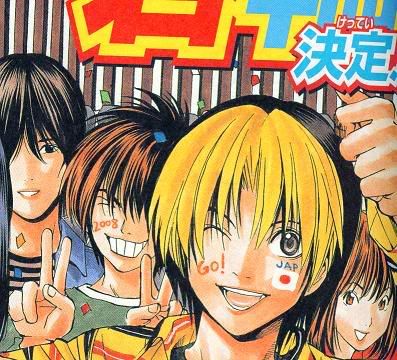
Hikaru no Go (ヒカルの碁 lit. "Hikaru's Go") is a popular Japanese manga and animeboard game Go written by Yumi Hotta and illustrated by Takeshi Obata. The production of the series' Go games was supervised by Go professional Yukari Umezawa (5-dan). The manga is largely responsible for popularizing Go among the youth of Japan since its debut, and in other areas such as mainland China, Hong Kong, Taiwan, and South Korea. More recently it has gained much popularity in the United States. The title is sometimes abbreviated 'HnG'. coming-of-age story based on the

First released in Japan in Shueisha's Weekly Shonen Jump in 1998, Hikaru no Go achieved tremendous success, spawning a popular Go fad of almost unprecedented proportions; it received the Shogakukan Manga Award in 2000 and creators received Tezuka Osamu Cultural Prize in 2003 for the series. Twenty-three volumes of manga were published in Japan, comprising 189 chapters plus 11 "omake" (extra chapters). The anime series, which was created by Studio Pierrot, ran for 75 half hour episodes from 2001 to 2003 on TV Tokyo, along with the 77-minute extra New Year's Special that aired in January 2004.


Storyline

The same basic storyline is followed by the manga and anime, with a few small changes between the versions. While exploring his grandfather's shed, Hikaru stumbles across a Go board haunted by the spirit of Fujiwara no Sai, a fictional Go player from the Heian era. Sai wishes to play Go again, having not been able to since the late Edo period, when he possessed the body of Honinbou Shuusaku, an actual Go player of that period. Sai's greatest desire is to attain the "Kami no Itte" – "Divine Move," or the "Hand of God" – a perfect game. Because Hikaru is apparently the only person who can perceive him, Sai inhabits a part of Hikaru's mind as a separate personality, coexisting, although not always comfortably, with the child.

Urged by Sai, Hikaru begins playing Go despite a lack of interest in the game. He begins by mimicking the moves Sai dictates to him, but Sai tells him to try to understand each move. In a Go salon, Hikaru defeats Akira Touya, a boy his age who plays Go at professional level. Akira subsequently begins a quest to discover the source of Hikaru's strength, an obsession which will come to dominate his life.

Hikaru becomes intrigued by the great dedication of Akira and Sai to the game and decides to start playing solely on his own. He is a complete novice at first, but has some unique abilities to his advantage; for instance, once he has a basic understanding of Go, he can reconstruct a game play by play from memory. Through training at Go clubs, study groups, and practice games with Sai, he manages to become an insei and later a pro, meeting various dedicated Go players of different ages and styles along the way. While Hikaru is at this point not yet up to the level of Akira, he demonstrates a natural talent for the game and remains determined to prove his own abilities to Akira, Sai, and himself.

Effect on the popularity of Go

Hikaru no Go dramatically increased the popularity of Go in Japan and elsewhere, particularly among young children.[1] Go professional Yukari Umezawa served as the technical advisor for the manga and promoted it on behalf of the Nihon Ki-in.[2] She had a short 5 minute special at the end of every episode instructing kids how to play Go. One of the reasons that she helped make Go so popular was because she was called "best looking Go Professional". The manga also spread Go throughout The United States. As a result, many high school and middle school Go clubs were started by students influenced by the manga.


This manga review was taken from here

Wednesday, November 28, 2007

Battle Royale

Writer: Koushun Takami and Masayuki Taguchi

Illustrator: Masayuki Taguchi

Content Guide: Intense scenes of violence, sexuality, and language. Not recommended for younger readers.

You've Won!

Imagine you won the lottery.

Now imagine that the prize was to be dropped off on a deserted island with your classmates. Add into the fact that the only way off the island is to kill each and every one of them. If you don’t, you will die, either by their hands or by the bomb that’s in the collar around your neck. Now who wants to play?

The Story

Battle Royale is about an alternate future in a military society that is ruled by a dictatorship. For one reason or another, 9th graders in a graduating class are pulled by random to compete in a game of life and death, but mostly death, called The Program. The kids are told that there are rules to the game:
  • All kids must kill each other until there is only one student left.
  • Each student is supplied with food, water, and a random weapon.
  • Each student wears a collar that has a bomb in it and monitors life signs.
  • There are designated danger zones that are addedd throughout the game. If you go there, your collar explodes.
  • If, at the end of a 24 hour period, someone has not died, then all of the collars explode.

They are each given their equipment and sent out on an abandoned island. After that, its every person for themselves.

The story centers mostly around Shuuya and Noriko, a young couple banded together to find a way to beat the system. There is Kawada, a grade repeater with surprising knowledge of the game. Most of the kids are like Shuuya and Noriko, desperate to avoid the true nature of the game, to kill. But then there is the too cool and calm Kazuo Kiriyama, and Mitsuko, psychotic and over sexual, especially for being a 9th grader. These two rapidly rack up the kills in an attempt to be the last one left.

Pulling all of their strings is the enigmatic Yonemi Kamon, the headmaster of The Program. Yonemi is sick, twisted, and violent, the perfect person to oversee such a gameshow.

Soon, the body counts start to grow. Either by themselves or others, death seems inevitable to the students of Junior High Class B. Will they massacre each other, or is there another way.

History

Battle Royale started as a novel by author Koushun Takami. What was to be an entrance into a mystery writing competition was passed over due to its controversial content. The book was later published in 1999 and became a smash hit in Japan, despite people in the Japanese government calling for censorship. The book has since been translated into English.

The book was later redone as both a manga series and movie that came out with one month of each other. The manga was written by Koushun Takami and Masayuki Taguchi and stayed close to the novel. The film was directed by Kinji Fukasaku and quickly became a hit in Japan. Although the film has not been released in theaters in America, it quickly established a cult following through its DVD releases. It can be rented and bought at many different locations. A sequel to Battle Royale was released in 2003 under the title Battle Royale 2. Many fans consider this movie not as good as the first. Novelist Koushun Takami had no involvement with the film.


Review
The idea of this story completely intrigued me. A whole 9th grade class taken to an abandoned island and forced to kill each other? Sounds very sadistic. I’ve read a few volumes of the manga, watched the movie, and plan on getting the novel soon. Guess I’m hooked.

One appeal to this is that it is so over the top. Like movies, books, and comics before that have used violence to help make a point, Battle Royale appears to fit into that mold. The movie was very bloody and gruesome, with the manga being more so. In the first volume there are full splash pages dedicated to showing close ups of students with their faces shot off. Very disturbing indeed.

At times, Battle Royale felt like a guilty pleasure, like I was doing something wrong just by reading it. The manga and movie have stuck with me and I find myself thinking about why this or that happened. About the point of the whole thing. About what my reaction to a situation like that would be. Would I give up and kill myself either in fear or protest, band with others to find a way out, or revel in the chance to go utterly psycho and let forth every dark inhibition that my mind can conceive? Kind of a sobering thought.

I think these are the things that make Battle Royale an interesting journey. Be warned, the manga and movie are very graphically violent, more so because of who is doing the killing, namely children. There is also a lot of foul language and the manga was at many times sexually explicit. All of it was so over the top as to force you to think about the point of it all.

Conclusion

If these kinds of things put you off, by all means, pass this one up. But if you like to struggle with your own inner demons to arrive at perhaps a better place, then you might want to give Battle Royale a try. In any event, it will stick with you for awhile, and that is one mark of a very good piece of work. In the end it is up to you.

This review was taken from here