Showing posts with label Takeshi Obata. Show all posts

Monday, December 3, 2007

Hikaru No Go

Story : Yumi Hotta
Mangaka : Takeshi Obata
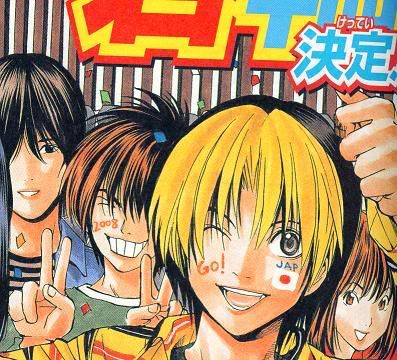
Hikaru no Go (ヒカルの碁 lit. "Hikaru's Go") is a popular Japanese manga and animeboard game Go written by Yumi Hotta and illustrated by Takeshi Obata. The production of the series' Go games was supervised by Go professional Yukari Umezawa (5-dan). The manga is largely responsible for popularizing Go among the youth of Japan since its debut, and in other areas such as mainland China, Hong Kong, Taiwan, and South Korea. More recently it has gained much popularity in the United States. The title is sometimes abbreviated 'HnG'. coming-of-age story based on the

First released in Japan in Shueisha's Weekly Shonen Jump in 1998, Hikaru no Go achieved tremendous success, spawning a popular Go fad of almost unprecedented proportions; it received the Shogakukan Manga Award in 2000 and creators received Tezuka Osamu Cultural Prize in 2003 for the series. Twenty-three volumes of manga were published in Japan, comprising 189 chapters plus 11 "omake" (extra chapters). The anime series, which was created by Studio Pierrot, ran for 75 half hour episodes from 2001 to 2003 on TV Tokyo, along with the 77-minute extra New Year's Special that aired in January 2004.


Storyline

The same basic storyline is followed by the manga and anime, with a few small changes between the versions. While exploring his grandfather's shed, Hikaru stumbles across a Go board haunted by the spirit of Fujiwara no Sai, a fictional Go player from the Heian era. Sai wishes to play Go again, having not been able to since the late Edo period, when he possessed the body of Honinbou Shuusaku, an actual Go player of that period. Sai's greatest desire is to attain the "Kami no Itte" – "Divine Move," or the "Hand of God" – a perfect game. Because Hikaru is apparently the only person who can perceive him, Sai inhabits a part of Hikaru's mind as a separate personality, coexisting, although not always comfortably, with the child.

Urged by Sai, Hikaru begins playing Go despite a lack of interest in the game. He begins by mimicking the moves Sai dictates to him, but Sai tells him to try to understand each move. In a Go salon, Hikaru defeats Akira Touya, a boy his age who plays Go at professional level. Akira subsequently begins a quest to discover the source of Hikaru's strength, an obsession which will come to dominate his life.

Hikaru becomes intrigued by the great dedication of Akira and Sai to the game and decides to start playing solely on his own. He is a complete novice at first, but has some unique abilities to his advantage; for instance, once he has a basic understanding of Go, he can reconstruct a game play by play from memory. Through training at Go clubs, study groups, and practice games with Sai, he manages to become an insei and later a pro, meeting various dedicated Go players of different ages and styles along the way. While Hikaru is at this point not yet up to the level of Akira, he demonstrates a natural talent for the game and remains determined to prove his own abilities to Akira, Sai, and himself.

Effect on the popularity of Go

Hikaru no Go dramatically increased the popularity of Go in Japan and elsewhere, particularly among young children.[1] Go professional Yukari Umezawa served as the technical advisor for the manga and promoted it on behalf of the Nihon Ki-in.[2] She had a short 5 minute special at the end of every episode instructing kids how to play Go. One of the reasons that she helped make Go so popular was because she was called "best looking Go Professional". The manga also spread Go throughout The United States. As a result, many high school and middle school Go clubs were started by students influenced by the manga.


This manga review was taken from here

Monday, November 19, 2007

Blue Dragon

Story: Tsuneo Takano

Art: Takeshi Obata (Hikaru no Go, Death Note)

Synopsis

In a world reminiscent of our medieval Europe, creatures called Shadows have invaded the world. Born in darkness, Shadows have no shape or form, but when they emerge into the world of light, they take over the body of living creatures, and through these they gain bodies for themselves. There are 3 types of Shadows, but regardless of what type they are, they cannot manifest themselves without light.

Ral, a prisoner kept in perpetual darkness by his father Lord Roy, was possessed by a Shadow when he was just a baby. For 15 years he was kept in darkness, but one day the assault of the Shadows grow too strong, and the people of the castle must rely on his power. Yet he’s been kept as a prisoner for 15 years, and Ral had promised Grado to take revenge on the people who first took them prisoner. In addition to this, Grado wishes to overthrow the current ruler of the Shadow world, and in exchange for lending Grado his intellect, Grado will lend Ral his power.

Ral attacks Roy as soon as he is freed, but Rin protects him from the guards who rushes to protect their lord. Seeing Rin for the first time, Ral is greatly interested by the difference between males and females, and asks Rin to teach him about women. In exchange, Rin asks him to kill the Shadows currently assaulting the castle.

Jumping off the tower, Ral and Grado fly down amongst the Shadows. Grado manifests himself in Ral’s shadow, which the largest of the Shadows recognise as The Raging Demon Blue Dragon. Grado easily dispatches all but the largest Shadow, which tries to run away, but is killed just as easily by Ral. Amidst the cheers of the villagers, Rin takes Ral away for his ‘lesson’, and the villagers wonder if their saviour has finally come.

Thoughts

Takeshi Obata is back with a new serialisation, and that is some good news indeed. His track record shows hits after hits - with his most recent and famous series being Hikaru no Go and Death Note. Blue Dragon is something markedly different from his previous works though - it’s unlike Hikaru no Go or Death Note, which are mostly set in the modern world with a fantasy twist, but is set in a medieval fantasy world where monsters run free.

This hasn’t stopped Obata from delivering his high quality art though. The change in setting doesn’t seem to hamper him, but rather provides him with more creative freedom. Like the death gods found in Death Note, the Shadows take various forms, some even having the ability to transform. Their non-humanoid appearances gives Obata more space to exercise his imagination and design, and although none yet are as memorable or as full of impact as Ryuk and his ilks, Grado looks truly fearsome. In short, Obata’s art is as good as ever, and there’s really nothing to complain about.

What about the story? So far it’s hard to judge, but it seems the story is going to center around how Ral and Grado overthrows the Shadow Queen. The two protagonists, Ral and Grado, who constantly talk to each other, provide two different types of hero - Ral, who knows nothing about the world, has infinite room for evolution and growth, while Grado seems to have a deep and interesting background, though how much focus will be given to him remains to be seen.

The first chapter also leaves a number of mysteries waiting to be solved. Apart from Grado’s background, what is the reason for their special blending, why wasn’t Ral completely taken over by Grado like the others possessed by Shadows? The Shadows claim they want to exterminate humans before they destroy the planet, so what is the world of Blue Dragon really like, how are the humans, who lack our destructive technology, on path to destroying the planet? Why did Grado, who is obviously a powerful Shadow, pick a little baby to possess?

Although it’s hard to say what the story will turn out to be like, I have some faith in whoever it is that picks the writers for Obata’s manga. Both Hikaru no Go and Death Note had outstanding stories, although they were great in vastly different ways. How Blue Dragon will turn out remains to be seen, but I really look forward to reading more of it.


This manga review was taken from here

Saturday, October 20, 2007

Death Note

Story by Ooba Tsugumi
Art by Obata Takeshi (The mangaka of Hikaru no Go)


Story & Characters

In short, the story, as already said, is mainly about a notebook which is a tool of the gods of death to, as the name of the notebook already says, causes death in people. This book falls into the hands of a high school student, who has his own idea of an ideal world. However in his journey of achieving it, he faces powerful adversaries who try to stop him from reaching his ideals, or tries to take the note. I shall stop here in case i provide too many spoilers.

The story is very deep, with well-created characters with unique personalities. The thing i like about this book is that the characters are all very human like (apart from their unbelievably strong analytical thinking) and each of them have a unique personality.

Light, the main character, for example, is illustrated to give a very clear image of a high-school genius who has surpassed most of his peers' academic abilities, and is bored with his routine life, and yearning for something new. He also gives us an image of a person who will go the distance to get to his ideals (why not, since he has the ability to kill).

even Ryukuu and Remu, the gods of death in the story, are given well-described personalities, and the gods of death are different themselves. Indeed it is a great addition to the already deep human characters.

The story by itself, is also full of twists and turns. Frankly, i myself have not completed the manga, but the story is such that one will never expect what will happen, except that he/she will expect that whatever that happens will be unexpected. The prospect that anyone will suddenly die also will lead a reader to be very much interested in the book, and will yearn for the next book after the current one. The twists in this story is so unexpected that, somewhere in the story, the reader faces an almost complete change of characters and roles. Indeed, the plot-thinking skills of Tsugumi Ooba cannot be under-estimated. The only bad thing is that, somewhere the changes are so sudden that i myself have no idea how the writer is going to end his story.
Great plot indeed. i give it a 10.

Rating
10 (excellent)

Art

The characters are rather lifelike as compared to other artists like clamp, where everyone looks almost the same. Not that i do not like stuff by clamp, but the art of deathnote is indeed very well drawn.

Characters also have faces which match their personality and backgrounds. The image of Light for example, being of a respectful, middle-class, background, gives the air of a gentleman. Misa, being a young and innocent girl is also depicted very well, with her blonde hair(or white in the manga) and large eyes, is exactly what you expect to see while viewing a teen idol.

The gods of death are also drawn very well. They are in no way pretty nor handsome, but pretty much the opposite. They are scary looking, with tentacles as hair, sharp teeth and sometimes rotting parts of bodies. However it really gives one the image of a 'god-of-death'. The realism in the art shows us that indeed, there is ugliness in the world, and this realism really fits in well with the dark story.

Expressions are also very well depicted. Expressions of shock, hopelessness, and agony are common in this story, and all of them are very well drawn, and kind of makes the readers feel exactly what they are feeling too.

Settings in the story are well drawn too. say, in a certain room, much attention is given to the details, such as the stuff on a table, being well arranged or messy. Indeed takeshi obatataks much pride in his work, and gives absolutely no nonsense. There are not much action scenes however, so theres actually not much chance for the artist to show off his skills in drawing such scenes.

Rating
8 (good)

Sound

haha there is obviously no sound, as already said this is a manga review. I shall just review on the dialogues.

The dialogue takes up pretty much of the manga, as this is mainly a story about a person's mind and his ways to achieve what he wants. This can be a good thing as it makes each book worth its money(since the reader takes so much time to read the dialogue). However the dialogue may be a bit too much for some people and they may deem it boring. I myself slept while reading book 1 halfway, not because it is boring, but rather i got tired from reading the large amount of words in the book.

The thing i like best about the dialogue is that, there are NO STUPiD CaTch phrases. Characters in the book talk and think like normal people, which is a very very good thing...


Rating
7 (above average)

Presentation

Overall a very nice presentation, totally worth it.

The only bad thing was jus that there are too many words in the book. Not that it is anyone's fault, as the words are necessary to tell the story well. This happens in the chinese version of the comic, at least.
The presentation of the comic itself is clear cut, and different situations, for example flashbacks are well represented by a black border.

Desperate situations, scenes of suspense, etc are also very well presented, and in such a way that the reader may realise his heart is beating quickly and his hands are starting to swear(at least in my case).

Though this is mainly a serious story, there are few times of humour, not too few such that the book will be boring and droning, but also not too much as to make this story a complete joke. The use of humour in places are certainly appropriate, as it does lift up the readers' spirits in the process of reading such a suspense-filled story.

In conclusion, it is a very good mangas that teenagers and certain adults will enjoy. It is indeed a good read.

Rating
9 (very good)

Final Verdict

8.83 (very good)


This manga review was taken from here